Custom Software vs Ready-Made Software: Which Is Better for Your Business?
Learn the difference between custom software and ready-made software, including cost, features, scalability, security and which option is better for your business
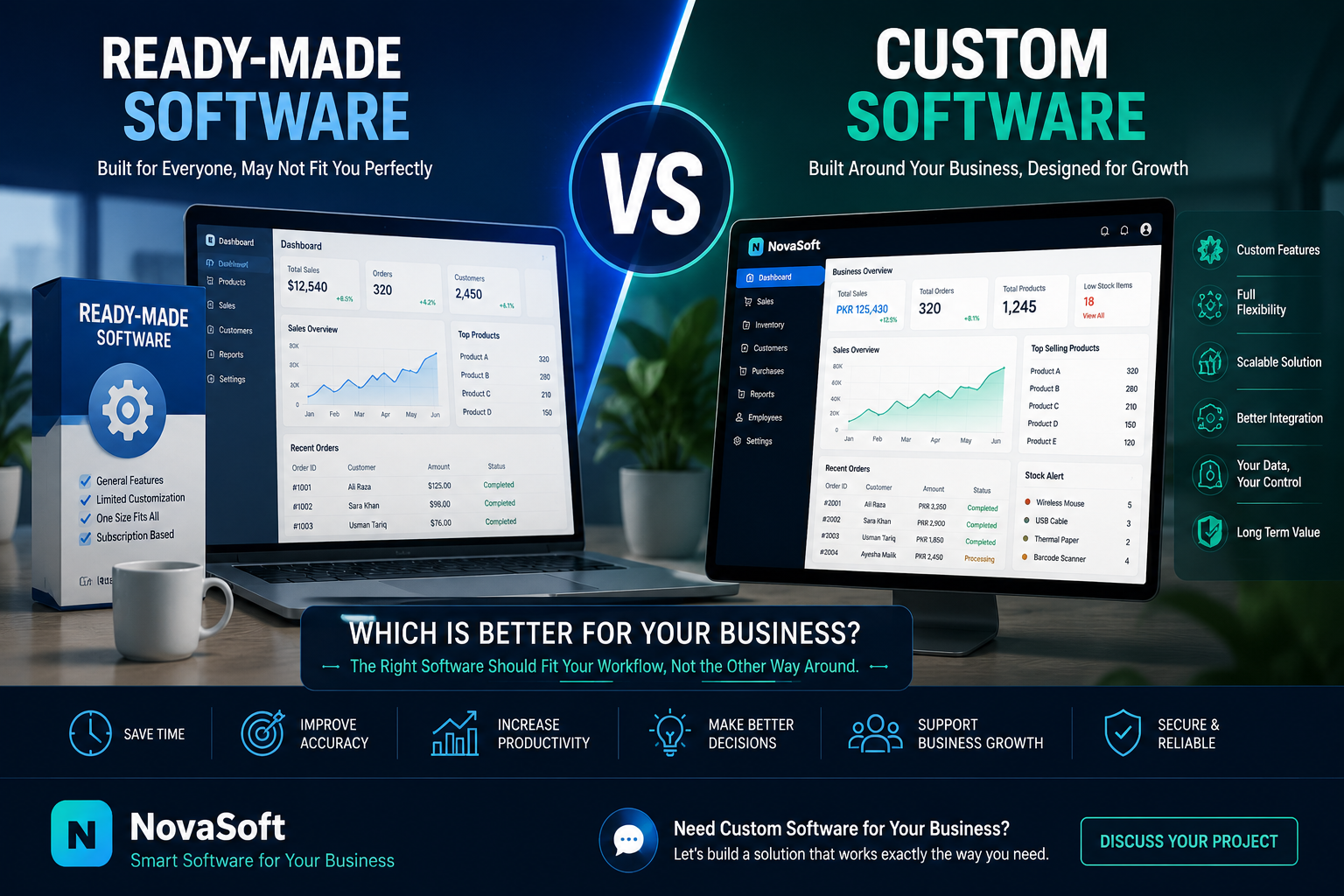
Every business has different requirements. Some businesses can work efficiently with standard software, while others need software designed specifically around their operations.
This creates an important question:
Should you purchase ready-made software or develop custom software for your business?
Both options have advantages and disadvantages. The right choice depends on your budget, business processes, future plans and required features.
What Is Ready-Made Software?
Ready-made software is developed for a large number of users rather than one specific business.
The same software is normally sold or provided to many customers.
Examples can include accounting applications, inventory systems, POS systems, CRM software and office applications.
Ready-made software is usually designed to solve common business problems.
What Is Custom Software?
Custom software is developed according to the specific requirements of a particular business or organization.
Instead of changing your business processes to match existing software, the software can be designed around the way your business already operates.
Custom solutions can include:
POS and inventory systems
Business management systems
Desktop applications
Web applications
Document management systems
OCR solutions
Reporting systems
Workflow automation
Customer management systems
Let's compare the two options.
1. Features
Ready-Made Software
Ready-made software normally provides a predefined set of features.
These features may be useful for many businesses, but you may receive functions you never use while still missing something important to your workflow.
Custom Software
Custom software allows required features to be planned according to the needs of the business.
For example, a business may require a specific billing process, special reports, different user roles or a unique inventory workflow.
These requirements can be incorporated into a custom system.
2. Flexibility
Ready-made software usually provides limited customization.
You may be able to change settings, but major changes normally depend on the software provider.
Custom software provides greater flexibility because its functionality can be designed around business requirements.
Additional features may also be developed later as requirements change.
3. Initial Cost
Ready-made software generally has a lower initial cost because development costs are shared among many customers.
Some products use monthly or yearly subscriptions.
Custom software usually requires a larger initial investment because it is developed specifically for one customer.
However, price depends heavily on the size and complexity of the project.
4. Business Workflow
Every organization has its own way of working.
With ready-made software, employees may need to adjust their workflow according to the software.
With custom software, the system can instead be designed around the existing workflow.
This can be particularly useful for businesses with specialized processes.
5. Scalability
Business requirements can change over time.
A small company may eventually need more users, departments, reports or functionality.
Ready-made software may require upgrading to another package or subscription when these requirements increase.
A properly planned custom application can be designed with future expansion in mind.
6. Integration
Businesses often use several different systems.
For example, a company may use separate systems for sales, inventory, customers and reporting.
Custom software can potentially integrate different workflows into one solution or connect with other supported systems.
The exact integration possibilities depend on the technologies and services involved.
7. Support and Maintenance
Ready-made software normally receives updates from its provider.
This can be convenient because individual customers do not need to manage software development themselves.
Custom software requires ongoing maintenance when operating systems, business requirements or technologies change.
For this reason, businesses considering custom development should also consider long-term maintenance.
8. Security
Security depends on how software is designed, configured and maintained rather than simply whether it is custom or ready-made.
Established ready-made products may have dedicated security teams and regular updates.
Custom software can provide business-specific access controls and security requirements, but it must also be developed and maintained properly.
Businesses should therefore evaluate security separately when choosing either option.
9. Ownership and Control
The amount of control you have over ready-made software depends on its licensing terms.
Normally, customers receive the right to use the software rather than ownership of its source code.
Custom software arrangements can provide greater control, but ownership and source-code rights depend on the agreement between the customer and developer.
These terms should be discussed before development begins.
10. Which Option Is Better?
Ready-made software may be suitable when:
Your requirements are common
You need software immediately
Your budget is limited
Standard features are sufficient
You do not require significant customization
Custom software may be suitable when:
Your business has a unique workflow
Existing software does not provide required features
You need specialized reports or automation
Different departments need to work within one system
You expect requirements to expand in the future
There is no single correct choice for every organization.
Before making a decision, identify the problems you want the software to solve and compare the long-term cost and benefits of each option.
Final Thoughts
Ready-made software can be an excellent solution when standard features meet the requirements of a business.
Custom software becomes valuable when a business requires functionality that existing solutions cannot provide effectively.
The important thing is to choose technology according to actual business requirements rather than simply selecting the option with the largest number of features.
NovaSoft provides custom software development for businesses requiring tailored solutions, including POS systems, inventory management, desktop applications, websites, document and OCR solutions, and business management systems.
If you have a specific software idea or business requirement, you can submit your requirements through the NovaSoft Custom Development section.
Need Software for Your Business?
NovaSoft develops custom business software, POS systems, Windows applications and websites.
Discuss Your Project