Django vs Flask: Which Python Framework Is Better for Web Development in 2026?
Compare Django and Flask for Python web development in 2026. Learn the differences in features, security, scalability, development speed and ideal use cases.
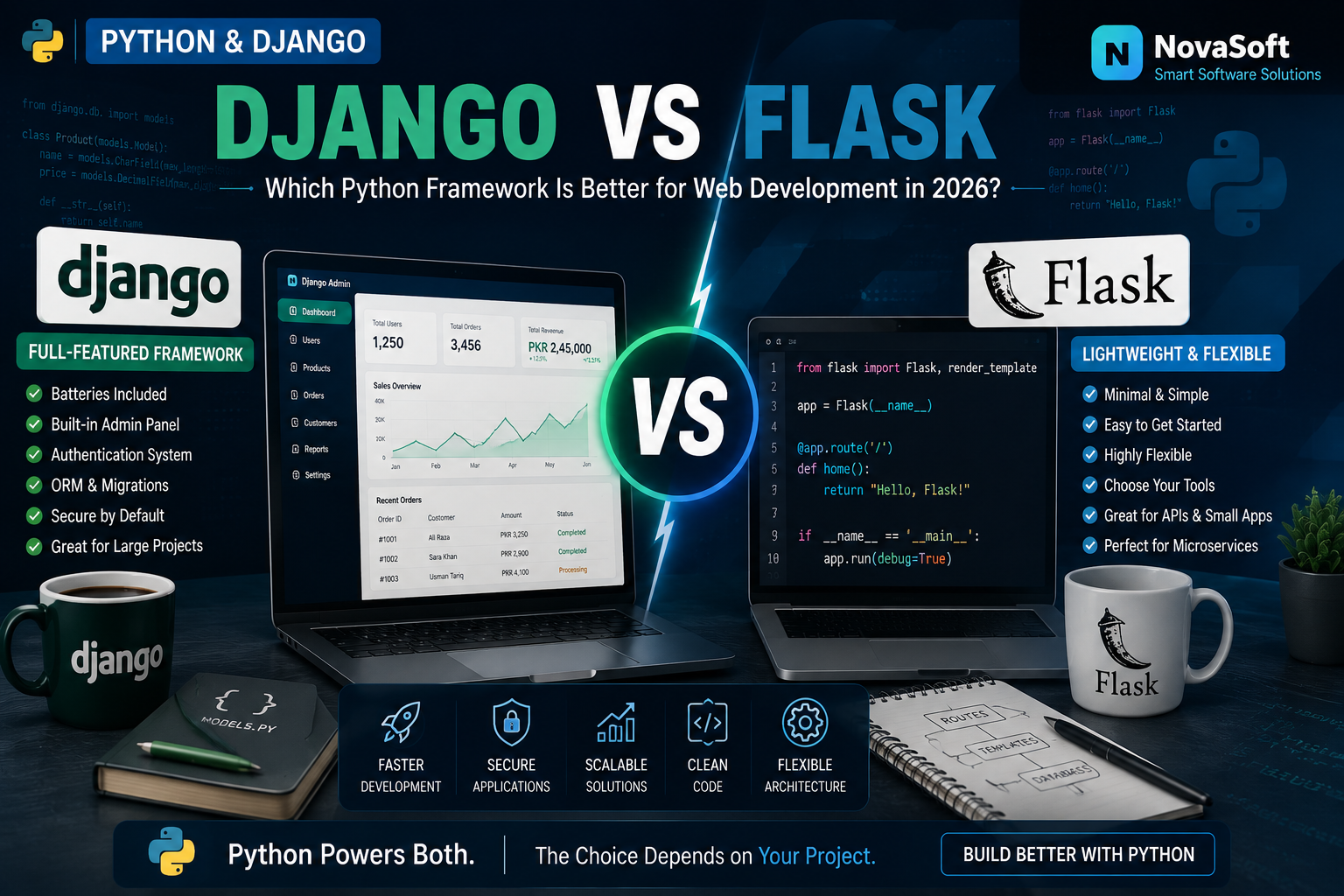
Python is one of the most popular programming languages for web development, automation, data processing and artificial intelligence.
When developers want to build a web application using Python, Django and Flask are two commonly considered frameworks.
Both can be used to build powerful web applications, but they follow different approaches.
In this guide, we will compare Django and Flask to help you understand which framework may be more suitable for your project.
What Is Django?
Django is a high-level Python web framework designed to help developers build complete web applications efficiently.
It provides many important features out of the box, including:
Admin panel
Authentication system
Database ORM
URL routing
Forms
Security features
Template system
Sessions
Database migrations
Because many features are already included, developers can build complex applications without installing a separate package for every basic requirement.
What Is Flask?
Flask is a lightweight Python web framework.
Instead of providing a large number of built-in components, Flask gives developers a smaller foundation and allows them to add the libraries and extensions required by their project.
This makes Flask flexible and relatively simple for smaller applications.
1. Django vs Flask: Basic Approach
Django follows a "batteries included" approach.
Many common web development tools are already available within the framework.
Flask follows a minimal approach.
It provides the basic functionality required to build a web application and allows developers to select additional components themselves.
2. Ease of Learning
Flask can initially appear easier for beginners because a basic application can be created with relatively little code.
However, larger Flask projects may require developers to understand and configure several additional libraries.
Django has more concepts to learn at the beginning, including models, views, templates, URLs and migrations.
Once these concepts are understood, its structured approach can be useful for managing larger projects.
3. Admin Panel
One of Django's well-known features is its built-in administration interface.
Developers can register database models and manage information through a web-based admin panel.
This can be especially useful for:
E-commerce websites
Inventory systems
Content management
Business applications
Customer records
Product management
Flask does not provide the same built-in administration system by default.
Additional packages or custom development are normally required.
4. Database Management
Django includes an Object-Relational Mapper, commonly called an ORM.
The ORM allows developers to work with databases using Python models instead of writing SQL for every operation.
Django also includes a migration system for managing database structure changes.
Flask does not require a particular database system or ORM.
Developers can select database tools according to their requirements.
5. Security
Security is extremely important for modern websites.
Django provides built-in protections for several common web security concerns when its features are used correctly.
It includes mechanisms related to areas such as:
Cross-Site Request Forgery protection
SQL injection protection through ORM usage
Clickjacking protection
Password handling
Authentication
Flask can also be used to build secure applications, but developers have more responsibility for selecting, configuring and maintaining the necessary components.
Regardless of framework, secure development practices and regular updates remain essential.
6. Development Speed
For applications requiring authentication, an admin interface, database management and forms, Django can save development time because many components are already included.
For small applications or simple APIs, Flask can be quicker to start because of its minimal structure.
The faster option therefore depends on the type of project.
7. Flexibility
Flask provides developers with considerable freedom over project structure and third-party components.
This can be useful when a project needs a very specific architecture.
Django provides more conventions and structure.
This may reduce flexibility in some situations, but it can also make larger applications easier to organize consistently.
8. Scalability
Both Django and Flask can be used for scalable web applications.
Scalability depends on more than the framework itself.
Database design, caching, server configuration, application architecture and infrastructure can all affect performance.
Therefore, choosing Flask does not automatically make an application faster, and choosing Django does not automatically make it more scalable.
9. When Should You Choose Django?
Django can be a good option for projects such as:
Business management systems
E-commerce websites
Online marketplaces
Customer portals
Content-based websites
Inventory applications
Large database-driven applications
Websites requiring user accounts and administration
It is particularly useful when a project needs several common web application features from the beginning.
10. When Should You Choose Flask?
Flask may be suitable for:
Small web applications
Simple APIs
Prototypes
Microservices
Learning projects
Applications requiring a highly customized architecture
Its lightweight design allows developers to build around the specific requirements of a project.
Django vs Flask: Which Is Better?
There is no universal winner.
Choose Django when you need a structured framework with many built-in features.
Choose Flask when you want a lightweight foundation and greater control over which components are included.
For a large business application containing users, products, orders, payments and an administration system, Django may reduce the amount of functionality that needs to be developed from scratch.
For a small API or specialized service, Flask may be simpler.
Final Thoughts
Django and Flask are both valuable Python web development frameworks.
The correct choice depends on project size, required features, development experience and long-term requirements.
Instead of asking which framework is always better, ask which framework better matches the application you are building.
NovaSoft uses modern development technologies to build websites, business applications and customized software solutions.
If your business requires a custom web application or software system, you can submit your requirements through the NovaSoft Custom Development section.
Need Software for Your Business?
NovaSoft develops custom business software, POS systems, Windows applications and websites.
Discuss Your Project